03 September 2012

News from Essex, with Beth Chatto

Crossing the border into Essex last week the skies were noticeably brighter. I walked into Beth Chatto's garden before opening time and wandered on my own around the calming lakes in the water garden. There was a 1960s house in its midst, and a slim lady of a certain age walking around with a watering can who didn't see me. I tiptoed around the carpet of turf.

Even after the gardening public began to step gingerly around, talking quietly, the garden retained this feeling of being private, completely imbued with the personality of the woman who created it. No gardening by committee here: the acanthus above is allowed to flop because it looks interesting. It makes a good picture.


"I aim to make pictures with form, texture and colour," says Beth Chatto later as we sit on a bench in the Gravel Garden. The sense of peace and quiet has long gone and children are charging around. The world famous Gravel Garden is a former car park and even now it seems to be the main route for deliveries. A parcel van reverses towards us, beeping loudly. "I don't mean a picture hanging on a wall, with a frame," she continues serenely. "It's an evolving picture... Which means there is a lot of editing. Trees and shrubs double in size; you put things down as ground cover and then they take over... Just this morning we were going around and I was saying 'let's start again with this.'"

There was no garden or house here before 1960, just dry Essex land. The layout does not follow Victorian guide lines but is free and fluid and yet curiously of its time. The planting follows the Japanese 'line of beauty': "The structure of the bed forms a triangle, and within that triangle there are more triangles." They are essentially giant island beds and what could be more 1960s than that.

The garden is very neat,  without being 'tidy'. "I like a certain amount of freedom but there needs to be control as well," says Beth Chatto. Although many of her ideas have caught up with her over the years Mrs Chatto has always been a radical. She is completely immune to gardening fashions. "Nature is not distracted by fashion," she says, almost indignantly. There are plants here which have earned their place and are outside the zeitgest. Right plant for the right place: it's her thing - she may even have invented the idea. If it works, it works. And by the way, she used grasses fifty years ago.

27 August 2012

The Naturalistic Look

"Are you leaving the garden?' asked my aged neighbour, a propos of nothing. I wasn't sure what she meant so carried on shouting whatever it was I was shouting. "Are you letting it go?" she interjected again. "I was looking over the fence and I thought, 'Kendra's decided to let her garden go.'" Now I got it. I pointed out that we'd been away for a few weeks and you know, we're all a bit busy to be gardening all the time.

On my way to the west country the next day I got a message from a production company saying they wanted to use the front of our sweet little cottage for a tv programme. They'd spotted it a month before and its slightly rambly front porch would be perfect. Ha, I thought, can't wait to tell the neighbour.

Self-seeded, relaxed, 'naturalistic' gardens are good for modern people without help. People born before World War Two might favour dahlias strapped against bamboo with white string but that is because they are following the old head gardener model. These days we don't like to tell the garden who's boss in such a bullying way. Design brings order out of chaos. But gravel is best without grass growing through it; a green path really shines when it's been edged, and a lawn should be of a  determinate length. Grass which is just long, with nothing growing in it but grass, drags down the whole picture.

Suddenly our garden has started to sink into the long grass. The meadow under the fruit trees is the same length as the lawn, with circles here and there where cats have been bedding down. After nine years of brilliance the lawnmower broke down, to coincide with the arrival of the film crew. (They filmed elsewhere).

Monty Don said on twitter yesterday: "The most interesting line a garden can walk is the one that marks the point between being and not being."

Or is it all about tidy grass?

27 July 2012

The Last Word in Brick...

…Is ‘Elizabethan’. Better still, Elizabethan brick with Elizabethan pointing. I found myself poking around Vita Sackville-West’s bedroom the other day, with Sarah Raven as my guide. She pointed out that one of the walls had been messed about with in the 1930s and it was not quite as lovely as the untouched Elizabethan wall, below.

Here, the Elizabethan wall is reflected in a hand-painted mirror leaning against a 1930s brick wall.

Sissinghurst is a brick fetishist's dream. Plastered walls reveal their underpinnings; brick garden walls are accompanied by brick garden paths; stone alpine sinks are held aloft on brick legs. It's a pinky-reddy-brown Kentish brick and it provides a warm backdrop for the yellow of a Mermaid rose or the pink of Blossom Time. It's so magical, this brick, that it puts red hot pokers into a different context, and they look really very fetching.
 

23 July 2012

What to Grow Against a Brick Wall, Part Two

Gardenista is a nice American online sourcebook and the week before last there was a post on brick walls - what to grow on them. I was at Sissinghurst on Thursday and it's all about brick. So here is chapter two to that particular story.

The brick at Sissinghurst is narrow, sometimes curved and often 500 years old. And yet a lot of it is smothered and covered. This is part of the look: Harold Nicolson's rigid lines and vistas are tempered with Vita Sackville-West's romantic effusions. Above: Baby's Tears, feared by some. This is where it belongs, adding blur to the perpendicular.

There is a tall and wide curved wall at Sissinghurst which is not ancient, but was built in the 1930s. Vita and Harold arranged for the construction to be carried out when they were away but despite the carefully sourced brick there was dismay on their return. Too much mortar! Now, there is a drape of purple clematis covering almost all of it. Different wall here.

But the other walls look best, in my opinion, when they are allowed to show through. The planting can draw attention to their beauty, instead of disguising it. Above: cobaea scandens, the cup and saucer vine, does some polite covering, before exploding into Mexican exuberance later on.

The semi-private living quarters, in which a small amount of sandstone mingles with the brick. And the new-looking terracotta pots: would Vita have tolerated them?

15 July 2012

Science with Peter, the Comeback

Science with Peter has always been a popular item here at News from Nowhere, but recently we have been busy reporting news from elsewhere. It is with great joy then that we can reveal that Peter and his scientific ideas have found a glamorous new home over at the Sarah Raven blog, Garlic and Sapphire. As his press agent, I'd like to point out that he is featured over there on MY corner of the blog, which has had top billing all week. It is called The Why and the Wherefore. Why indeed? Don't ask me, ask Peter.

I love asking Peter 'silly' questions. The other day I was at a friend's, drinking tea outside and looking in the direction of some bindweed silhouetted against the sky. It had climbed to the top of its host and now, reaching ever higher, it seemed to be giving us a cheery wave. "Why don't slugs eat bindweed?" my friend asked with disgust.

As everyone has noticed, slugs are a very successful monoped at the moment, slithering up windows and stealing into kitchens, racing towards the front door whenever one opens it...

Peter has a maddeningly simple answer: "Bindweed is toxic to most things, including us and slugs." One small nibble is all they need to send them off towards something which is valued. In a world facing domination from slugs and snails, weeds as villains come a poor second. So, while no-one's looking, what if tenacious ground elder and toxic bindweed had a fight to the death? Which one would win?

King Kong v. Godzilla or, the attractive flowers of aegopodium podagraria in mid-embrace with convolvulus arvensis, in Northamptonshire.

04 July 2012

The Last of the Garden Clichés

Ahem. A weed is a plant which is in the wrong -- A weed is a plant which no-one has found a use -- Please. Why not sidestep the matter entirely by planting everything in grass, and let the peonies fight it out with the buttercups. It doesn't matter how the latter behave because they look lovely with Welsh poppies, and with ragged robin, and campion. They mingle with the green and provide welcome accents of colour. The green floor is a very forgiving background for any plant and though it might get long and rough you could argue that your peonies have never looked better, putting on a shorter, stouter appearance. The same can be said for achillea and centaurea: they will flop no more. And in grass peonies are not nearly as irritating for the ten months in which they do nothing.

At Cottesbrooke Hall Gardens tall plants are an important part of the whole idea. It is a garden with height. One of these plants which has made itself very at home in the borders is valeriana, recently seen in bud in the gold-winning meadows of SW3 (above, photo by Jim Powell) before blooming slightly further north around the Terrace Border in Northamptonshire. Actually, it pops up everywhere, even amongst the classical statuary in the ultra-formal Forecourt, far away from where it was intended.

This is why it is making a steady march down toward the Wild Garden, with human help, where it can scatter itself amongst the buttercups and devil's bit scabious. It looks good there; it looks good everywhere. But there are so many fascinating plants in the formal gardens that they need more space to perform and I'm not sure whether valerian would be described as fascinating, though certainly useful in bringing the planting up to eye level. The question is, now that valeriana has found a home among the wildflowers, what is it exactly? And do stop going on about weeds!

For more lower-upper class plants see The Observer Organic Allotment Blog.

25 June 2012

Cott'sbrooke Characters

 
Special Plants' Derry Watkins, with purple accessories.

 Rosie Bose of Glendon Hall lets down her hair.

Ancient Industries ingenues are recommended.

Carrier Company Tina plus Hepburn cheekbones.

Gina Portman of Folk at Home.

James Alexander-Sinclair with his new wooden spoon.

 
Cotts snapper James Corbett. 

Swing Seat Des and Niwaki Jake. 

 Turned out nice: a sunny late afternoon in Northamptonshire.


02 June 2012

The Thirteen Clocks

On a fine, sunny day last week I visited Cottesbrooke Hall. Formerly known as Brooke Hall on these pages, it was the setting for my year-long training with the Women's Farm and Garden Association, a good excuse to drive down the farm tracks of Northamptonshire at dawn before many long days of labour and toil. In a completely inspiring setting. I went to see my old friends in the Gardeners' Mess Room and then was allowed out into the park and 13-acre gardens.

Because every inch is combed through by the three and a half gardeners there is a lot more garden per acre than most people have with no acres. The planting density is higher. The Terrace is a classic double border in the country house style: the garden-visiting public demands this in a place with 'Hall' in its address. Ribbons of smart tulips were still flowering away thanks to the well-irrigated spring, but meadow flowers like corn cockle (below) are becoming a presence and they have crept and then marched into all the formal borders.

As always, it is the unplanned combinations that really sing in anyone's back yard. I was particularly struck by the dandelion clocks on a bank in the Wild Garden, mixing with camassia. The white globes crowding around the Chinese pagoda were like a mass of lanterns, making the place look like a storybook version of the East via the East of England.

Other choice weeds were planted at Chelsea this year, on purpose, and with their good friends the native wild flowers, they did not let the side down. For more raving about weeds and friends do visit my very own Way of the Weed, over at the Observer, including the reliably lively comments section.

Herbalism inspired by Julia the herbalist, also known as

26 May 2012

A Bit of Breathing Space at Chelsea

Amongst the frenzied and over-scripted coverage of the Chelsea Flower Show on tv it was a relief to see some calm, in the gardens themselves. As well as BBC presenters, the planting can get a bit excitable. Last year the garden that won Best in Show had patches of bare earth, with pillars lying on the ground. Cleve West, its designer, dared to leave well alone again this year and won Best in Show for the second year running. There's something going on here. Joe Swift's irises (above) look very happy with a bit of park sand around them, the euphorbia keeping a respectful distance, the cornus far enough away not to plunge these sun-loving plants into shadow. The gravelly sandy stuff they use in French parks is an excellent foil for the flowers and trees.

Why does every inch of a border have to be stuffed with plants - to prevent weeds? In her romantic meadow garden Sarah Price planted herb robert, red clover, horsetail and even - plantain. At Chelsea!! Weeds are allowed in and so is a bit of disorder, or an idea of disorder. Plants wandered on to the straight paths making them less razor sharp, and also bringing attention to that nice gravelly sandy stuff, which seeds love to germinate in.

Ditto Tom Hoblyn and his Lake Como-influenced garden. Plants grow hither and thither, as seen in this 360º panoramic: possibly the best way to see the Chelsea show gardens without being there in person. Photos and tv can only focus on the broader picture or the minute detail of say, Nigel Havers. Three more panoramic gardens:
Andy Sturgeon
Arne Maynard
Diarmud Gavin

All images by Jim Powell.


20 May 2012

The Freezing Fete

The fete at Great Easton is the best one in Leicestershire, and this is partly because it is held in a garden. The tea, cake and village hall china are reliably excellent and the plant stall demands careful planning: get there early or repent for a year. The book stall has a side line in ancient jigsaws and we bought one for £1 featuring classic cars outside a village pub with a church steeple in the background. Very Great Easton.

 Yesterday was possibly the most fun I've had at a fete and I think it was to do with the mad weather. My son was ensconced in fake fur (the hood on his parka was firmly up) and people were drinking tea with gloves on. The plant stall did not sell out in five minutes flat because people have rather given up on seeing flowers ever again. But the atmosphere was good, with friends, friends' parents and children's friends milling around and it was just as busy as it would have been in glorious sunshine.

As the temperature wavers between single and double digits, people become more full of hilarity. We aren't moaning about the weather any more. What's the point? It's all a joke, as the spring and summer slide away in a torrent of rain, wind and poor visibility. We are stronger in the face of adversity. God Save the Queen.

13 May 2012

It's Big and it's Hairy

In this season of Noah's Ark weather, ordinary gardens have had a lack of colour and flowers. The weeds though, are positively Old Testament. Dandelions on roadsides are two feet long and hairy bittercress (above) is becoming more embittered and increasingly hairy. In a normal world its little round leaves and miniature flowers will keep it at dolls house size, mainly because it is so easy to flick out, in passing. But until this weekend we've been avoiding outdoors altogether, and the weeds are having a wonderful time.

I had never noticed the existence of the hairy bittercress before reading Children and Gardens by Gertrude Jekyll. In her seductively bossy way she illuminates the virtue of the root: 'Put between two bits of bread and butter it is delicious.' The book is addressed directly to her audience of children, an attentive generation of proto-gardeners. No interruptions please as she further instructs: 'You eat it for nursery tea.'

Nursery tea may be enhanced by this perma-flowering weed but the same cannot be said of its constant companion, the shepherd's purse. Unless you can grab the latter before it flowers, the taste is dreadful. However: its healing qualities are immense, concerning the life force of a human being. Read all about shepherds' purse, cousin of the hirsute bittercress, in my 'Way of the Weed' latest, available to look at for free on the Observer Organic Allotment blog. See also what a real shepherd's purse was made of in the Comments section: this is often the most edifying part.

For genuine card-carrying herbalism visit Botanical Bird.


08 May 2012

The Bevel and the Deep Blue

A rainy day spent in Spitalfields yesterday, admiring everything, including doors and shutters. The doors are glossy and their numbers engraved, with scant reference to brushed nickel, chrome or brass.

We stopped to examine the recherché combo of brown and cream gloss or cadmium yellow with old mustard a couple of doors down but the main theme, without being at all boring was blue, bluey green, greeny blue and green, with a fascinating spectrum of subtle shades in between. They all go well with sooty brick. Some of the old houses have clung on to their peeling exteriors from past decades (not an accident), thus rendering colour choices absolutely unnecessary.

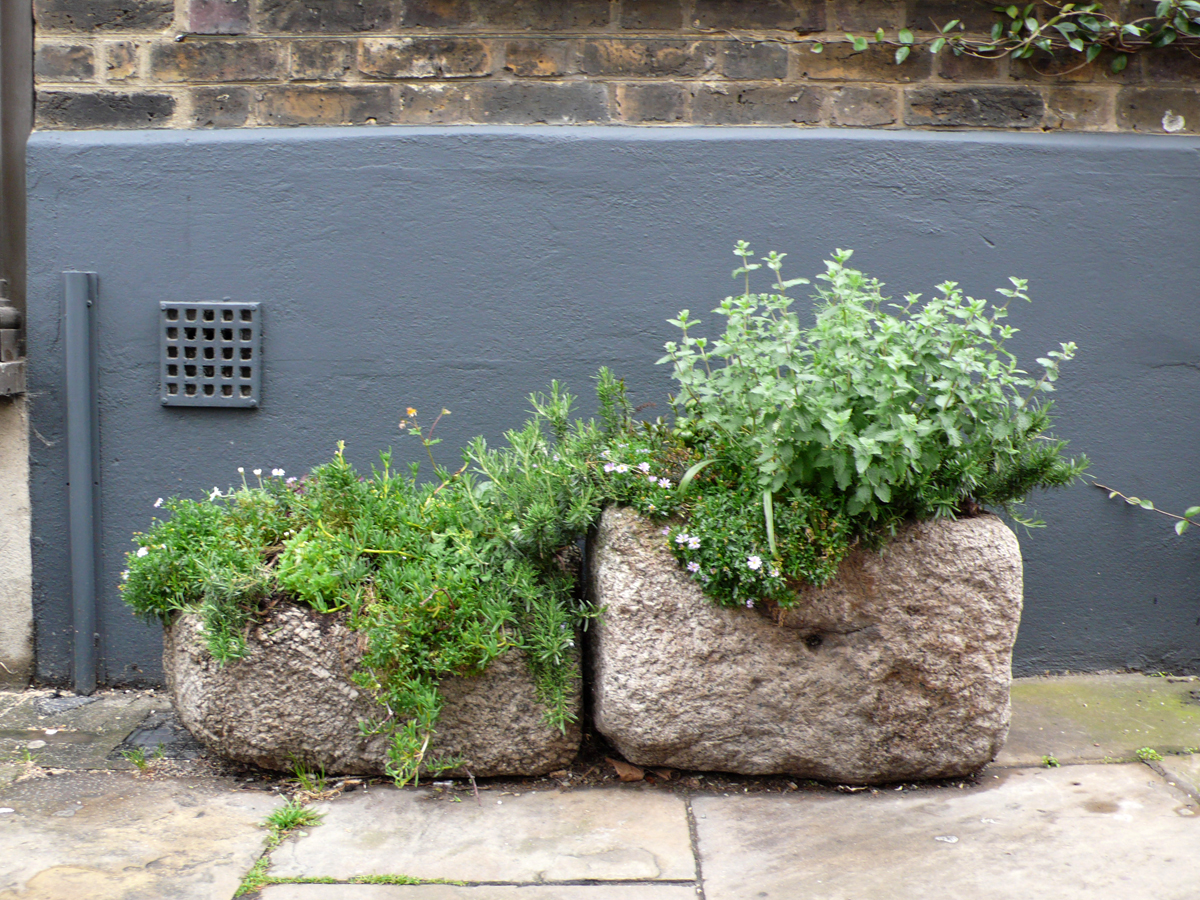
One perfectly presented house on Fournier Street, an ash tray's throw from the Ten Bells Pub on  Commercial Street, was sparsely accessorised with a couple of stone sinks on the pavement. Planted with rosemary, thyme and erigeron, they looked very desirable and not very nick-able, due to their considerable weight.

01 May 2012

Diluvian Diary

Tulipa 'Prinses Irene'
Flowers can look quite good in the rain. Obviously, they're even better just after but... anyway. Before the Deluge, we had plenty of sun but not many flowers, because it was only March. Back in those days I found myself hay making. Nick had cut down the long Karl Foerster grass around the Roman gods at Brooke Hall and people were getting a bit red in the face. It was not a great time to take pictures though, because it was all too glarey. Now, after the dismal, dull, dreary and depressing downpour it is easy to forget about Spring. The news is, it's still happening, and paid professionals go on working from eight till five making gardens look lovely, for someone to look at. It's an excellent time to visit gardens, (through the NGS or otherwise) because you might have the place to yourself and the really intensely hued flower petals are easier to photograph. Just trying to be positive.

Clematis Alpina 'Pamela Jackman'